Donald Trump and the Long Way Back to the White House
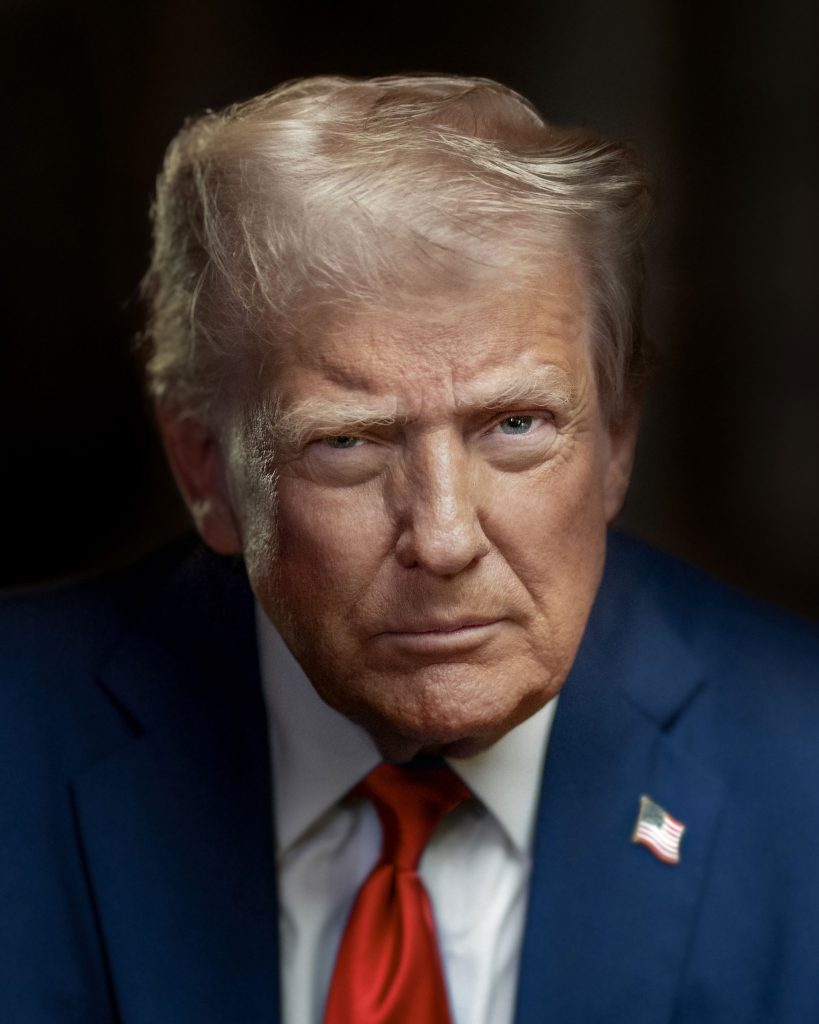
After defeat, four indictments, a felony conviction, and a bullet that grazed his ear at an outdoor rally in Pennsylvania, the 47th President took the oath of office indoors at the Capitol Rotunda. He is the first U.S. president since Grover Cleveland to serve non-consecutive terms.
The author lives in Palm Beach and is a frequent visitor to Mar-a-Lago.
Butler, Pennsylvania, a Saturday afternoon in July of 2024. The Trump campaign rally was outdoors, on the grounds of the Butler Farm Show. He had been speaking for roughly six minutes when the rifle fire began. Eight rounds, from a twenty-year-old shooter on a rooftop roughly a hundred and fifty yards out. One round grazed Donald Trump’s upper right ear; another killed Corey Comperatore, fifty, the former chief of the Buffalo Township Volunteer Fire Company, who died shielding his family. Two other men in the crowd were critically wounded. Sixteen seconds after the first shot, the Secret Service Counter Sniper Team had killed the shooter.
What happened next was the moment that crystallized the year. Trump, flanked by Secret Service agents, paused on his way off the stage and turned back toward the crowd. He raised his fist. He mouthed three words that the broadcast feeds caught and that the photograph froze: “fight, fight, fight.” It was a gesture that, in another political figure, would have been characterized as composed or theatrical. From this one, it read as continuation. He had been knocked down; he had stood back up; the response was the work; the broadcast was the proof.
The 2024 election was not decided by Butler. But a great deal of what followed it — the convention four days later, the fall campaign, the November win — drew on the iconography of that gesture. He had been within a fraction of an inch of being killed, and he had walked off the stage gesturing to his audience. To understand the road to a Republican convention nominating him for the third time, to a popular-vote-plus-Electoral-College win in November, and to an indoor inauguration at the Capitol Rotunda on January 20, 2025, requires a longer arc.
He is, today, the 47th President of the United States. He took the oath of office on a freezing morning at the Capitol Rotunda — the first indoor presidential inauguration in forty years, since Reagan’s second in 1985. His Vice President, JD Vance of Ohio, was sworn in alongside him; Melania Trump returned to the role of First Lady that she had left four years earlier. By the end of that first day, Trump had revoked seventy-eight of Joe Biden’s executive orders, withdrawn the United States from the Paris Climate Agreement and the World Health Organization, established the Department of Government Efficiency, and pardoned or commuted the sentences of about fifteen hundred people charged in connection with the events of January 6, 2021. “The golden age of America begins right now,” he said in the inaugural address.
Eighteen months into the second term, the political shape of it is not yet settled. But the structural claim is. He is the first U.S. president since Grover Cleveland — sworn in for non-consecutive terms in 1885 and 1893 — to come back to the office after losing it. Cleveland’s case is the only American precedent, and it is both an analogy and a contrast: Cleveland lost in 1888 in part on a tariff dispute he then ran on in 1892, and his second term is remembered for the issue he had returned on. What Trump has done is structurally singular in American political history. How it happened is the question this profile is built around.
The pre-political base is well-mapped. Born June 14, 1946, in Queens; the New York Military Academy in his teens; transfer to Wharton, where he took the bachelor’s in economics in 1968; and into his father Fred Trump’s real-estate business, which he came to lead in the early 1970s. The 1973 Department of Justice civil suit against the Trump Organization for racial discrimination in apartment rentals settled in 1975 by consent decree without admission of guilt. The 1980s and early 1990s produced the buildings that gave him his name as a brand — Trump Tower in 1983, the Atlantic City casinos — and the multiple corporate Chapter 11 filings that eventually followed (he did not personally file). Trump: The Art of the Deal, written in 1987 with Tony Schwartz, sold widely and built the deal-maker persona that the rest of his public life would use as scaffolding. The Apprentice, on NBC from 2004 through 2015, scaled the persona to weekly national reach.
The political emergence began on June 16, 2015, with the announcement at Trump Tower. The 2016 nomination at the Cleveland convention, the campaign against Hillary Clinton, and the Electoral College win 304 to 227 are by now familiar history. The first term — the Tax Cuts and Jobs Act of 2017, the USMCA renegotiation in 2020, the Abraham Accords in September of that year, two House impeachments and two Senate acquittals — was contested at every step. The November 2020 loss to Joe Biden by 232 to 306 was decisive, and so was the response: the months of legal challenges, the rally on January 6, 2021, the events at the Capitol that followed, the second impeachment, the second acquittal, the move to Mar-a-Lago as primary residence. The years between 2021 and 2024 were the wilderness period that the comeback arc requires, structurally, in order to exist.
The legal drumbeat through 2023 and 2024 is part of the spine because it never broke the campaign’s rhythm. In March 2023 the Manhattan District Attorney indicted him on thirty-four counts of falsifying business records, the case that would go to trial the next spring. In June and August Special Counsel Jack Smith brought two federal indictments — classified documents in the Southern District of Florida, and election interference in the District of Columbia. In August Fulton County, Georgia, brought a RICO indictment. The civil judgments came on a parallel track: E. Jean Carroll’s two federal verdicts, in May 2023 and January 2024, totaling more than eighty-eight million dollars in damages; Justice Arthur Engoron’s $355 million civil-fraud judgment in February 2024, later modified on appeal. On May 30, 2024, a Manhattan jury convicted on all thirty-four counts. He became the first U.S. president, sitting or former, convicted of a felony.
Six weeks later he was at Butler. Two days after Butler, the Republican convention nominated him and JD Vance. By November he had won the popular vote — the first Republican popular-vote winner since 2004 — and the Electoral College 312 to 226. On January 10, 2025, ten days before the inauguration, Justice Juan Merchan sentenced him in the New York case to an unconditional discharge: charges upheld, no fine, no probation, no jail time, the singular sentence that produced the singular posture in which he took the oath. The U.S. Supreme Court, on January 9, had denied his request for a stay by 5–4. He filed notice of appeal to the New York First Department on January 29, now represented by Sullivan & Cromwell. In November 2025 a federal appeals court remanded his removal-to-federal-court question for reconsideration. The federal cases had ended differently: Judge Aileen Cannon dismissed the classified-documents case in July 2024 on Appointments Clause grounds; Judge Tanya Chutkan dismissed the election-interference case in November 2024 after Smith moved to dismiss, citing the Department of Justice’s longstanding policy against prosecuting a sitting president. Both dismissals were without prejudice; neither was on the merits.
A profile assembles a verdict from pattern. Three patterns are visible across the public record.
The first is that, for this subject, the public-facing performance is not separate from the work; it is the medium through which the work gets done. The fist after the bullet is one example, but it is one of many. The entry music; the rally choreography; the Truth Social cadence; the Apprentice-trained instinct for camera and beat. Most political figures perform around the work — speeches around legislation, interviews around governance. For this one, the performance and the work are the same act, and have been for forty years. The point is character-revealing because it explains both the political durability and the responses to it: a presidency conducted in the medium of broadcast is responsive to a different feedback loop than one conducted in the medium of administrative process, and both supporters and critics have spent a decade learning, sometimes against their interests, to read the medium correctly.
The second pattern is the counter-puncher’s. Every documented hit produces a response. The Trump v. O’Brien defamation suit, filed in 2006 and dismissed in 2009. The responses to E. Jean Carroll, to Robert Mueller, to the two impeachments, to four indictments, to Butler. Each instance contains the same shape: a strike lands, a response follows, the response is at least proportional and frequently larger than the strike. This produces the political durability — the response apparatus has not stopped — and it produces the political cost, in places where particular responses extend beyond what the public record will support.
The third pattern requires more care. The Mueller Report, released in April 2019, found that the Russian government interfered in the 2016 presidential election in what it called “sweeping and systematic fashion,” through the Internet Research Agency’s social-media operation and the GRU’s hack-and-release operation against the Democratic National Committee. The report’s central finding on the Trump campaign side was the careful legal-standard sentence: the investigation, in the report’s words, “did not establish that members of the Trump Campaign conspired or coordinated” with the Russian government. The report documented more than one hundred and forty contacts between Trump or his associates and Russian nationals, WikiLeaks, or their intermediaries; it concluded that those contacts were insufficient to support a criminal conspiracy charge. The discrepancy between this finding and the four-year press cycle that often elided it is itself a fact about the public record. It is one item, not a wholesale reframe of the period; but it is the kind of item where the consensus take and the document do not match, and it is part of why Trump’s supporters arrived at 2024 with a specificity about elite-press credibility that the dominant frame mostly missed.
Comparables clarify by selection. Andrew Jackson is the obvious one, and the one Trump himself foregrounded: on February 1, 2017, ten days into his first term, he had Jackson’s portrait moved into the Oval Office. Jackson was the outsider populist of his era — the contested 1828 election after the 1824 House decision that gave John Quincy Adams the presidency; the rough-edged rhetoric; the patronage politics; the personality as instrument of policy. The American populist tradition that runs from Jackson through William Jennings Bryan, through George Wallace, through Trump is real, even if each instance is contingent on its own moment. Where Trump diverges from Jackson is in coalition-building: Jackson commanded a national party that ran on his name; Trump’s relationship to the Republican Party has been more singular and less institutional, though the second-term coalition is broader than the first.
Grover Cleveland is the dryer comparable and the more precise. Two non-consecutive terms (1885–1889; 1893–1897), the only previous American example of the structural pattern. Cleveland lost in 1888 in part on a tariff dispute that he then ran on in 1892. His second term is remembered for what he had returned on. The Cleveland analogue suggests, without predicting, that the issue a returning president returns on becomes the term’s organizing question. For Trump in his second term so far, immigration policy and the work of the Department of Government Efficiency look likely to occupy that role.
January 20, 2025. The Capitol Rotunda is not the National Mall; the cold made it the Rotunda. The crowd was inside; the sun was outside. JD Vance took the oath, the first Catholic Vice President since Joe Biden left the role; Trump took the oath; Melania returned to the role she had left four years earlier. The imagery of return was doing the work that morning, and the writer does not need to underline it.
What comes next will not be settled by inauguration day. Cleveland’s two terms are remembered for different things, and the question of which one defines him is still open more than a century after he left office. Whatever the second Trump term turns out to be, the comeback’s structural fact is now in the public record. The man at the rostrum that morning had nearly been killed by a bullet in July; convicted in May; sentenced to an unconditional discharge in January; and then, ten days later, sworn in. Whatever comes, the long way back to the White House is now part of the story the country tells about itself.
Further reading
Written by DJT Backyard
Responses (0)
No responses yet
More from DJT Backyard
Seventeen Months: Carl Cascio and the Palm Beach County GOP
Eighteen months ago the Palm Beach County Republican Party was making national headlines for internal turmoil. The voter-registration gap with the Democrats…
Melania, Re-read From 2026: Calibrated Restraint as a First Lady’s Position
Reviewing Melania Trump's October 2024 memoir from the vantage of 2026 — with the election decided and Melania again FLOTUS — lands…
Recommended from DJT Backyard
Accessibility
DJT Backyard aims to be accessible to all readers. We follow WCAG 2.1 AA guidelines. What we’ve done Color contrast meets or…
Candidates
The Republican candidates running for office in Palm Beach County and across Florida — incumbents, challengers, primaries, and the path to November.…
Contact Us
Get in touch with the editorial team at DJT Backyard. Text us From your phone, tap the button below — the SMS…
Editorial Standards
DJT Backyard publishes news and commentary from a conservative perspective on Palm Beach County and beyond. These standards govern how we work.…